Injuries are part of life's activities. I haven't met one person, in or out of dance, who hasn't experienced an injury.
The difference between injuries in dancers vs non-dancers is the importance of the extent of recovery of that injury.
The goal is to heal as fast as possible so that the dancer can get back to the insane hours of physical training.
By the way, that is something that pro athletes do not do because they prioritize recovery.
I recently had a conversation with a dance clinician at a University where she works with professional dancers and helps them reach the next level in their careers.
What she is seeing in the young adult dancers is directly related to the conversations we need to be having as dance moms.
We will talk about these gems in our podcast episode in a few weeks.
But for now, I'm sharing just some "alternative" therapies and approaches that came up during our conversation, therapies some of my clients are sharing with me, and a deeper dive into the most common PT adjunct therapy that many dancers get.
1. Platelet-Rich-Plasma Therapy
This is not new, but somehow most doctors do not consider it a therapy worth mentioning to their dancer patients.
Research on this therapy showed promise nearly a decade ago, but since then, only 'brave enough' practitioners have been using it for their patients.
While the research study testing its use focused on lower extremity injuries, the outcomes showed that 13 out of 19 participants healed. And the primary reason the others didn't benefit as much was due to the extent of their injuries.
When reading such research, I often consider multiple perspectives.
While yes, just 19 study participants is a very small number. We also want a control group in a research study to compare therapy outcomes with those of non-therapy groups.
The importance of appropriate scientific research in these 'alternative' therapies can't be understated.
But then, I hang my scientist hat and put on dance mom glasses with the following frame in mind:
If it helped one person, then there's a chance this can help my dancer, too.
While we did not use this PRP therapy for my dancer's injuries, as I haven't heard about it until just this week, I used this thought filter when helping my dancer heal the torn meniscus without surgery.
If we had PRP available, I would most definitely explore the possibility with her health provider.
Why?
Because you can always choose surgery, but you can't UNDO the surgery.
If it is not a true medical emergency, and after a thorough evaluation and consideration of the extent of the injury, conservative options may be even more appropriate. It is important to consider all the options.
2. Shockwave Therapy
Sound therapy is a true 'magic bullet' that has been used in Europe forever, but has been suppressed in the US -because it works without the pharmacological interventions that cost a lot more.
The precise name for this therapy is: Extracorporeal Shockwave Therapy (ESWT).
It involves using sound waves in short bursts to help recruit new growth factors, help grow blood vessels to deliver essential nutrients to the damaged area, help collagen formation at the injury site, and even disrupt bad nerve firing that causes pain at the injury site.
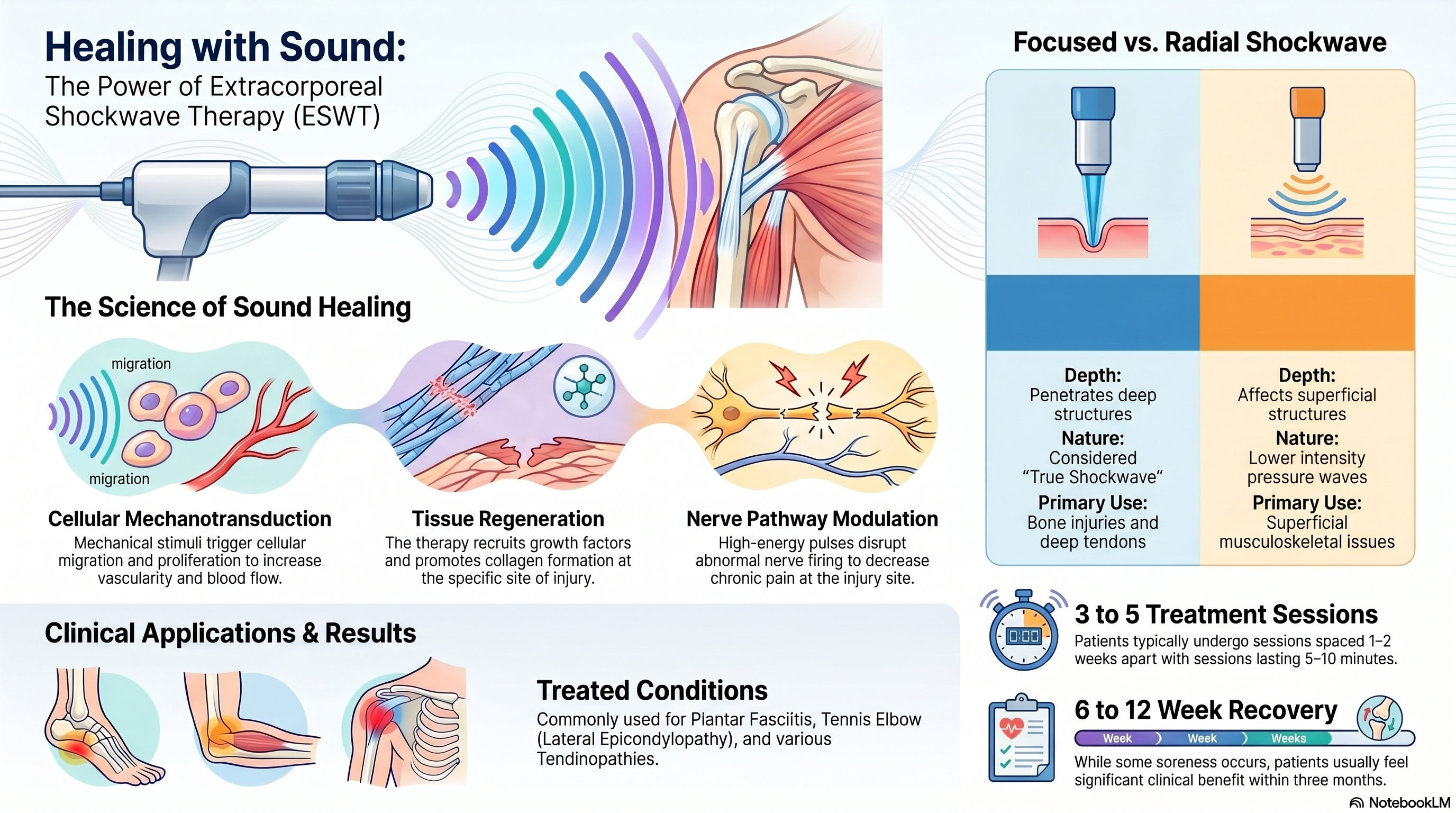
It is a remarkable therapy that every sports center should use, but since it works so well and is so much cheaper than surgery and medications, you can see why it didn't gain traction in the conventional medical circles.
This therapy also has only some research on very specific uses.
It also has an unpleasant 'side effect': it can be rather painful and can cause post-treatment soreness.
If you want to learn more about this therapy, here's a direct link to a place that uses it for athletes' care:
Here's the link to more precise information on this therapy.
3. PEMF
This is a much more common therapy, which can even be done at home.
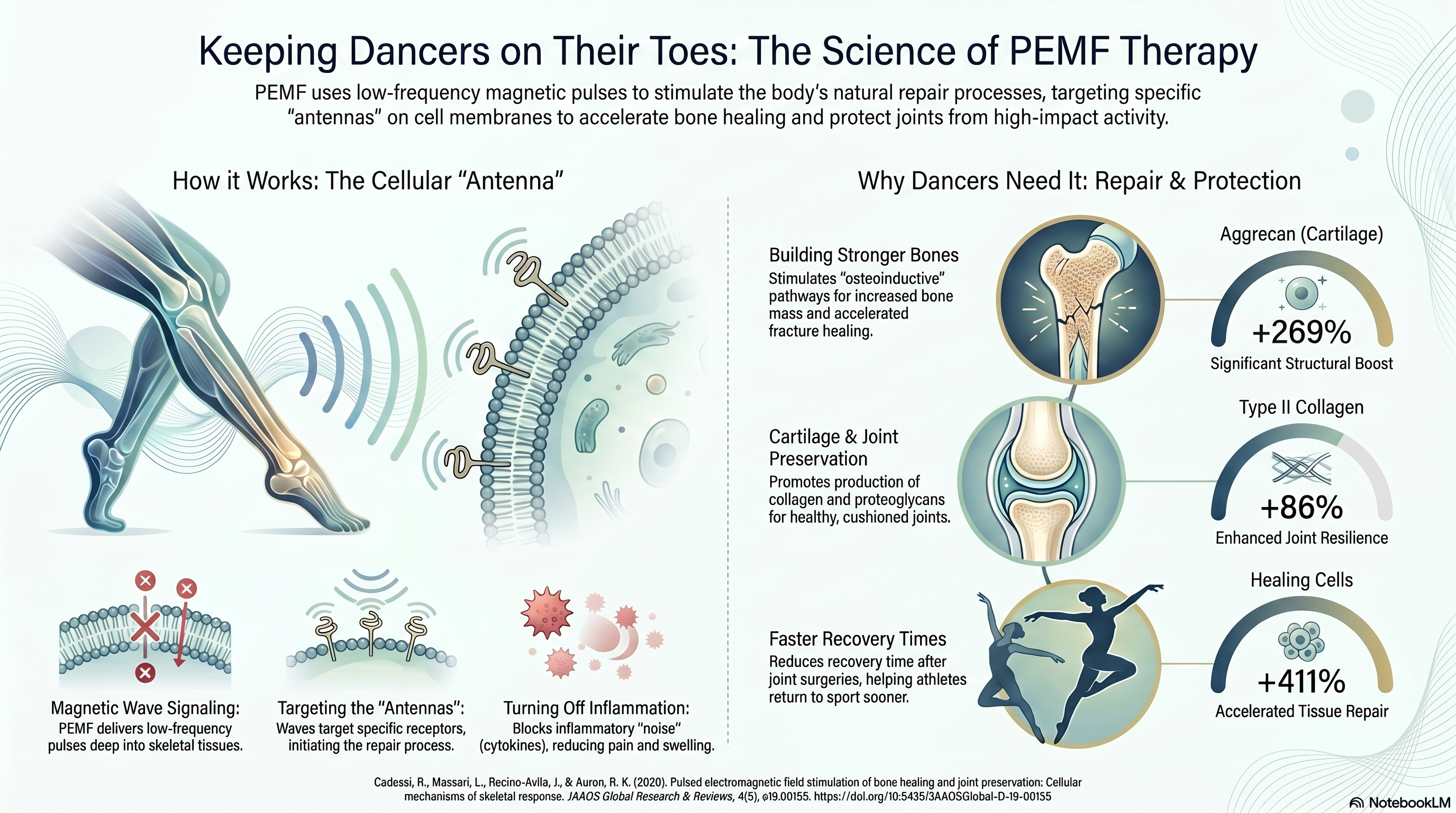
It uses electromagnetic energy to change the electric field in a treated tissue.
This is important because when the PEMF signal reaches the cells in the injury area, it activates receptors and causes a whole cascade of healing events.
It helps reduce inflammation by tuning down signals that trigger swelling.
It pushes the cells to build more collagen and bone-building cells, if that's what's needed at the injury site.
And PEMF may even block enzymes that normally inhibit cartilage production.
Here's a visual to help you understand how it works and why your dancer may benefit.
What is actually important here is recognizing that different modalities have distinct mechanisms of action. And that is why it is important to consider combination therapies rather than just one.
It is one of the challenging aspects of getting integrative and holistic medicine across to conventional providers because we view solutions from different perspectives.
Holistic approaches consider all possibilities, including combinations.
Conventional approaches often rely on deductive measures, using just one approach to see if it works.
The truth is that, just as life is multilayered, injuries are multilayered, and the solutions for them should be as well.
Using multiple modalities to get at a stubborn injury that's taking longer to heal may just be what it needs to cross that threshold.
It may be that PEMF on its own could not be as effective, but combined with multiple other modalities, it may enhance those other therapies.
This is the thinking we'd want to hear from our dancers' injury care team.
Do This Week:
- If your dancer has an injury, explore the alternative therapies we discussed with your dancer's provider.
- If your dancer is not injured, simply note these therapies and consider whether any, such as PEMF, could be injury-prevention therapies worth discussing with a trainer or a prophylactic PT.
- If your dancer is injured, reflect on how far you and your dancer have come on their healing journey! Sometimes having this perspective helps to keep moving forward, even with tough injuries.
And as always...
...if you have any follow-up questions, send me a DM on Instagram or email me your takeaways, questions, or concerns. I'll review them and give you my thoughts on what your next step could be.
team@thrivingdancers.com
PS: At Thriving Dancers, we don't use AI to write our content! We do use it to help create helpful infographics, check grammar, and pull specific research studies we're looking for. So what you'll always get from Thriving Dancers is human-synthesized, thought-through content that's always authentic! That's why sometimes you'll see NotebookLM on some of the included images, if we use it to create a helpful diagram :)
Dance Mom: Welcome to Thriving Dancers World! If you received this email as a forward from another mom and found it helpful, please sign up HERE so you won't miss out on future updates from us. You never know, something in our newsletter might have the power to transform your dancer's dreams for the better!